

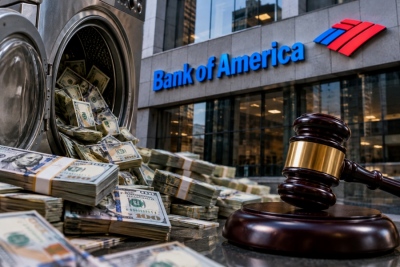
US regulatory authorities imposed fines totaling over $1.2 billion on Bank of America (BAC) due to widespread failures within its mechanisms designed to prevent money laundering and identify other illicit financial activities. According to the US Department of the Treasury, the second-largest bank in the US failed to adequately monitor trillions of dollars in transactions, while omitting to report suspicious activities totaling over $5 billion. Among the transactions taking center stage are capital transfers that may be linked to Chinese money laundering networks, drug trafficking, and fraud.
$1.2bn fine from FinCEN
The most significant sanction, amounting to $1.2 billion, was imposed by the Financial Crimes Enforcement Network (FinCEN), the US Department of the Treasury agency responsible for combating financial crime. This represents the third-largest fine in the history of the US Department of the Treasury, following the $3.4 billion penalty imposed on cryptocurrency exchange Binance in 2023 and the $1.3 billion fine against TD Bank in 2024. Concurrently, the Office of the Comptroller of the Currency (OCC), the primary regulatory agency for US national banks, imposed a $750 million fine, the largest it has ever levied. The OCC's sanction amount will be offset against the FinCEN fine rather than added to it. Separately, an $11.6 million settlement was agreed upon for sanctions violations, bringing total penalties to more than $1.21 billion. "Even the largest financial institutions are not above the law," declared US Secretary of the Treasury Scott Bessent.
Pressure on the stock - Earnings hit
Bank of America's stock slipped more than 2% in post-market trading Tuesday as investors digested the impact of the sanctions. Management disclosed that quarterly results will incorporate a "$1.2 billion non-tax-deductible charge, which will reduce net income by approximately $0.17 per share." A spokesperson for Bank of America noted in a written statement that compliance with anti-financial crime regulations constitutes a grave responsibility for the bank. As noted, the Charlotte, North Carolina-based group has invested billions of dollars in technology and deployed thousands of employees to combat financial crime and remediate identified deficiencies.
Inadequate controls on transactions and customers
US authorities determined that Bank of America's shortcomings were not isolated to a single area, but extended across transaction monitoring systems, customer due diligence controls, and internal oversight. According to authorities, the bank failed to report suspicious transactions exceeding $5 billion, of which over $1 billion pertained to illicit finance risks related to national security as well as other high-priority law enforcement activities. FinCEN reported that Bank of America admitted it willfully violated the Bank Secrecy Act, the US law establishing reporting and monitoring obligations to combat money laundering. Concurrently, according to the agency, the bank had essentially outsourced much of its responsibility for detecting suspicious activity to law enforcement agencies and other financial institutions. The US Department of the Treasury also argued that the bank prioritized revenue over compliance resources, resulting in suspicious transactions remaining uninvestigated for extended periods.
Warnings had preceded since 2024
The new sanctions arrive nearly two years after Bank of America's decision, in December 2024, to consent to a cease-and-desist order requiring it to rectify chronic weaknesses in its anti-money laundering mechanisms. However, according to the OCC, the bank failed to make sufficient progress despite prior supervisory intervention. "Bank of America's inadequate response to its Bank Secrecy Act deficiencies is unacceptable," stated Jonathan Gould, head of the OCC, citing ongoing internal control failures. The fresh intervention highlights the stricter posture adopted by US authorities toward banks failing to meet obligations to detect and report suspicious financial transactions.
$11.6m fine for sanctions violations
In a separate matter, the Office of Foreign Assets Control (OFAC) of the US Department of the Treasury announced an $11.6 million settlement for 475 alleged violations of sanctions programs concerning Russia, Iran, and other countries or activities. Under the new supervisory measures, Bank of America is required to retain an independent third party to review transactions not previously flagged as suspicious. Simultaneously, it will undergo independent reviews of its compliance systems and mechanisms.
"Reputational hit" for the bank, but cost manageable
Mike Mayo, a Wells Fargo equity analyst covering Bank of America, characterized the case as a "black eye" for the bank's reputation, while estimating that the one-off financial hit remains "digestible." The case underscores the substantial financial and reputational risks confronting even the largest banking groups when compliance and control mechanisms fail to satisfy regulatory mandates. For Bank of America, the immediate cost is reflected in the projected earnings charge. The broader challenge, however, centers on restoring internal controls and regaining the confidence of regulators and investors alike.
www.bankingnews.gr











Σχόλια αναγνωστών